Posted February 25, 2026
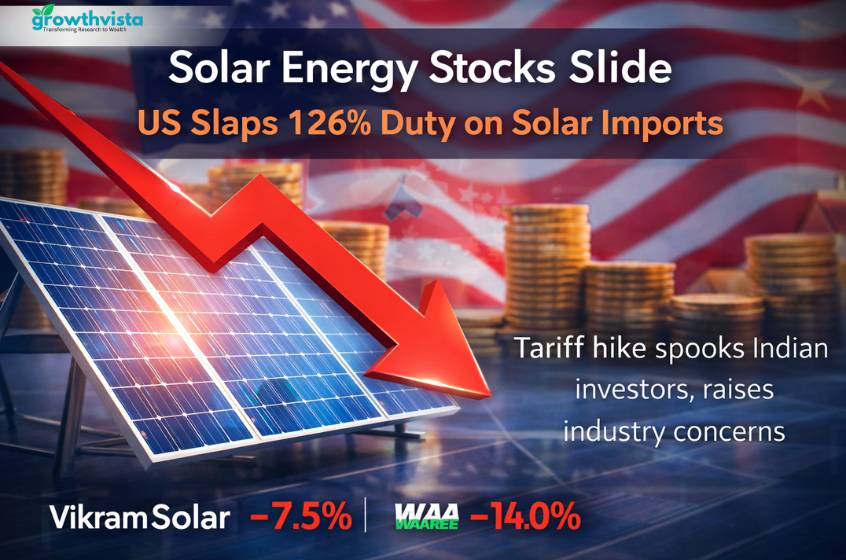
Waaree Energies Crashes 14%, Vikram Solar Slides Over 7.5% as 126% US Solar Import Duties Spook Investors – Key Details
Introduction – Why Are Solar Energy Stocks Falling Today?
The Indian stock market woke up to a sharp jolt on Wednesday, February 25, as solar energy stocks witnessed heavy selling pressure. Shares of Waaree Energies crashed by over 14%, Vikram Solar slipped more than 7.5%, and Premier Energies dropped nearly 10% in early trade.
What triggered this sudden panic?
The answer lies thousands of miles away — in the United States. The US government announced preliminary solar import duties of up to 126% on Indian solar products, accusing India of unfair manufacturing subsidies. This unexpected move rattled investor sentiment, sparking fears of revenue loss, rising costs, and disrupted export flows.
In simple words, the market doesn’t like uncertainty. And this decision created a storm of uncertainty for solar exporters.
Big Shock from the US – Understanding the 126% Import Duties
What Exactly Did the US Announce?
The US Commerce Department imposed preliminary import duties of 126% on solar modules imported from India. Alongside India, Indonesia and Laos were also hit with steep tariffs ranging between 81% and 143%.
These tariffs are separate from earlier global trade duties and were announced after the US concluded that exporters from these nations benefited from unfair subsidies, allowing them to undercut American manufacturers.
Why Did the US Impose Such High Tariffs?
The US claims that foreign subsidies enabled manufacturers to sell solar modules at artificially low prices, harming domestic solar producers. To protect American manufacturing and encourage local production, these massive duties were slapped on imports.
But here’s the irony — while this may help US manufacturers, it increases costs for project developers and consumers, potentially slowing the renewable energy transition.
Market Reaction – How Indian Solar Stocks Reacted
The stock market’s reaction was swift and brutal.
Waaree Energies Share Price Movement
Waaree Energies shares plunged 14.2% to ?2,591.1 on the NSE, marking one of the steepest single-day falls in recent months. The stock later recovered slightly but remained deep in the red.
Vikram Solar Stock Performance
Vikram Solar shares tumbled over 7.5% to ?171, reflecting investor anxiety over export exposure to the US market.
Premier Energies: Why It Fell Despite Low US Exposure
Premier Energies declined nearly 10% to ?699.35, even though its export exposure to the US is minimal. Analysts believe the fall was driven mainly by negative market sentiment and panic selling, rather than company-specific risks.
Export Exposure – Who Is Most at Risk?
Waaree Energies Export Dependence
Waaree Energies derives nearly 29% of its revenue from exports, with a significant portion coming from the US. This high exposure makes the company particularly vulnerable to trade restrictions.
Vikram Solar Export Revenue
Vikram Solar earns around 16% of its revenue from exports, including the US market. While not as exposed as Waaree, the impact is still significant.
Premier Energies – Minimal US Exposure
Premier Energies reportedly has negligible export exposure to the US, which explains why analysts see its decline as more sentiment-driven rather than fundamental.
Why Investors Panicked – Key Reasons Explained
Several factors combined to trigger panic selling:
-
Revenue Uncertainty: Export-heavy companies could face declining orders.
-
Margin Pressure: Higher duties mean squeezed profit margins.
-
Demand Risk: Increased costs may reduce solar installations in the US.
-
Policy Unpredictability: Sudden regulatory changes make long-term planning difficult.
In the stock market, fear spreads faster than facts, and this event proved it once again.
Impact on Indian Solar Industry – Short-Term vs Long-Term Effects
Short-Term Challenges
In the short run, Indian solar manufacturers may face:
-
Reduced export orders
-
Inventory pile-ups
-
Pricing pressure
-
Stock price volatility
These factors could weigh on quarterly earnings and investor confidence.
Long-Term Opportunities
However, the long-term outlook still holds promise:
-
Growing domestic solar demand in India
-
Government support through production-linked incentive (PLI) schemes
-
Global shift toward clean energy
-
Diversification into new markets
Just like a storm tests the strength of a ship, this phase will test the resilience of Indian solar companies.
US Trade Policy & Trump’s Stand on Renewable Energy
Former US President Donald Trump has historically favored domestic manufacturing and fossil fuel industries, often expressing skepticism toward renewable subsidies.
Though the US recently signed a bilateral trade agreement with India, the fresh duties signal that trade tensions remain unresolved, especially in strategic sectors like energy.
Global Solar Supply Chain – Why India Matters
According to BloombergNEF, India, Indonesia, and Laos accounted for 57% of US solar module imports in H1 2025.
Data from the US Commerce Department shows solar imports from India surged to $792.6 million in 2024, nearly nine times higher than 2022 levels.
This massive dependence explains why these duties have such far-reaching consequences.
Rising Costs & Impact on Consumers
Higher import duties mean increased project costs for US solar developers, which could:
-
Slow down solar installations
-
Increase electricity costs
-
Delay renewable energy targets
In simple terms, the burden eventually falls on consumers.
About Waaree Energies – Company Overview
Business Model & Product Portfolio
Waaree Energies is a leading manufacturer of solar PV modules, solar cells, energy storage systems, and green hydrogen solutions.
Its portfolio includes:
-
HJT modules
-
N-type modules
-
Mono PERC modules
-
Flexible and special modules
Manufacturing Facilities & Innovation
The company operates manufacturing plants in Tumb, Nandigram, Chikhli, and Surat, Gujarat, and continues to invest heavily in R&D and innovation.
About Vikram Solar – Company Profile
Manufacturing Strength
Vikram Solar is among India’s largest solar module manufacturers, with strong production capacity and global reach.
EPC & O&M Services
Apart from manufacturing, the company offers:
-
Engineering, Procurement & Construction (EPC)
-
Operations & Maintenance (O&M)
-
Integrated solar solutions
About Premier Energies – Company Snapshot
Solar Manufacturing
Premier Energies is an integrated solar cell and module manufacturing company, with strong domestic market presence.
EPC & O&M Capabilities
The company has executed:
-
Over 266 MW ground-mounted projects
-
Over 22 MW rooftop projects
-
More than 178 MW in O&M services
What Should Investors Do Now?
This is where emotional discipline matters most.
Instead of panic selling:
-
Evaluate company fundamentals
-
Understand export exposure
-
Monitor government policies
-
Diversify your portfolio
Remember, volatility creates opportunity for patient investors.
Expert Opinions & Market Outlook
Most analysts believe the sell-off is sentiment-driven, and fundamentally strong companies may recover once clarity emerges.
However, short-term volatility is likely to continue as investors digest evolving trade policies.
Key Risks to Watch Ahead
-
Further escalation of trade tensions
-
Changes in US renewable policies
-
Global demand slowdown
-
Currency fluctuations
Opportunities Hidden in the Chaos
Every market crash plants seeds for future wealth.
Long-term investors may find attractive valuation opportunities in quality solar stocks if business fundamentals remain intact.
Conclusion
The sharp fall in Waaree Energies, Vikram Solar, and Premier Energies highlights how global policy decisions can instantly shake domestic markets. While the 126% US import duty has created short-term turbulence, India’s solar story remains structurally strong.
For investors, this is a reminder that markets move on emotions, but wealth is built on patience, discipline, and fundamentals.
Disclaimer
The information provided in this article is for educational and informational purposes only. It does not constitute financial, investment, legal, or tax advice. Please consult with a certified financial advisor or a SEBI-registered professional before making any investment decisions. The author and publisher are not responsible for any financial losses or legal consequences incurred as a result of using this information
